
Exposé Online
What's old
Exposé print issues (1993-2011)
- 1 (October 1993)
- 2 (February 1994)
- 3 (May 1994)
- 4 (August 1994)
- 5 (October 1994)
- 6 (March 1995)
- 7 (July 1995)
- 8 (November 1995)
- 9 (March 1996)
- 10 (August 1996)
- 11 (February 1997)
- 12 (May 1997)
- 13 (October 1997)
- 14 (February 1998)
- 15 (July 1998)
- 16 (January 1999)
- 17 (April 1999)
- 18 (November 1999)
- 19 (May 2000)
- 20 (October 2000)
- 21 (March 2001)
- 22 (July 2001)
- 23 (December 2001)
- 24 (April 2002)
- 25 (September 2002)
- 26 (February 2003)
- 27 (August 2003)
- 28 (December 2003)
- 29 (April 2004)
- 30 (September 2004)
- 31 (March 2005)
- 32 (September 2005)
- 33 (May 2006)
- 34 (March 2007)
- 35 (January 2008)
- 36 (October 2008)
- 37 (July 2009)
- 38 (July 2010)
- 39 (Summer 2011)
Reviews
Phillip Golub — Loop 8/9
(Bandcamp Greyfade 013, 2026, CD / DL)
by Henry Schneider, Published 2026-11-03
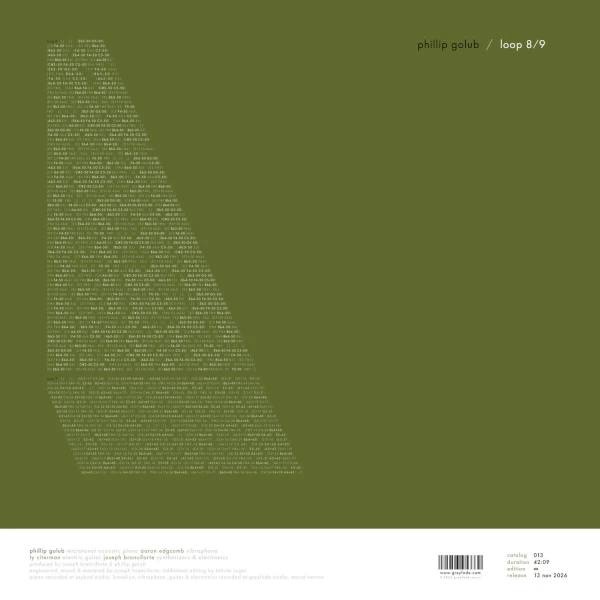
There is a difference between inviting a listener into a musical world and merely opening the door. Loop 8/9 finds pianist and composer Phillip Golub standing comfortably inside a universe of microtonal relationships, just intonation, resonance, and infinitesimal variation. The problem is that the rest of us are left standing at the threshold. Golub's latest installment in his ongoing loop-based series consists of two extended pieces, each built from a distinct tuning system and performed with what the accompanying notes describe as a quartet of retuned piano, vibraphone, electric guitar, and electronics. Yet for most of the album, those distinctions remain more apparent in concept than in practice. What reaches the ear is largely a slow-moving succession of piano figures circling through the same territory again and again. “Loop 8” unfolds over 21 minutes at an almost unwavering tempo and dynamic level. Notes repeat. Small variations occur. Occasionally a bass note appears, briefly suggesting a new direction before the piece settles back into its familiar orbit. The experience is less like following a composition than watching a pianist sit down, discover an appealing pattern, turn on a recorder, and become so absorbed in the sound that twenty minutes pass unnoticed. To be fair, the music is not static. Golub is clearly exploring something. The problem is that the changes occur at such a microscopic level that they gradually lose their ability to register as meaningful events. There are microvariations in timing, resonance, and tuning, but over time they become nearly indistinguishable from the loop itself. The irony is that constant variation ultimately creates an impression of sameness. “Loop 9” introduces more dissonance and internal friction. Notes occasionally seem to trip over one another, and there is somewhat greater rhythmic flexibility through scattered triplets and altered groupings. Yet despite the rougher harmonic landscape, the overall effect remains much the same. There are changes, but no forward movement. The music seems permanently stuck in the present tense. As I listened, an unexpected metaphor came to mind: sensory deprivation. By restricting changes in tempo, dynamics, texture, and register, Golub creates a listening environment in which the smallest musical event acquires exaggerated significance. For some listeners, that may prove meditative or even transcendent. For me, it raised a more fundamental question: Why? Golub may be fascinated by the microtonalities and microvariations generated by his tuning systems. He may hear endless discoveries within these loops. Unfortunately, that fascination proves difficult to share. The composer appears fully immersed in this sonic universe, while the listener remains outside looking in. After forty-plus minutes, I understood what Golub was doing, but I was never convinced why I should spend forty-plus minutes listening to it. In the end, Loop 8/9 certainly meets the definition of sound events occurring in time and space. Whether it succeeds as a compelling musical journey depends on whether one finds Golub's private exploration worth crossing the threshold for. I never quite made it inside.
Filed under: New releases, 2026 releases
Related artist(s): Phillip Golub
What's new
These are the most recent changes made to artists, releases, and articles.
- Review: Phillip Golub - Loop 8/9
Published 2026-11-03 - Release: Happy Family - Live 4138
Updated 2026-11-02 14:58:58 - Review: Spirits Burning & Michael Moorcock - The End of All Songs - Part 1
Published 2026-11-02 - Review: Paolo Almeida - Love in Motion
Published 2026-11-01 - Review: The Instigations - Miscreantics
Published 2026-10-31 - Review: Andy Juhl - Go Where the Sun Goes
Published 2026-10-30 - Release: Phideaux - Orion
Updated 2026-10-29 13:26:39 - Release: Kanaan - Kanaan
Updated 2026-10-29 12:32:02 - Review: Das Rad - Open Up the Door
Published 2026-10-29 - Review: 4Element - Double Life
Published 2026-10-28 - Release: The Demonstration Tapes - Second Amendment
Updated 2026-10-27 14:35:40 - Release: The Demonstration Tapes - First Amendment
Updated 2026-10-27 14:34:58 - Artist: The Demonstration Tapes
Updated 2026-10-27 14:33:58 - Release: Tic Tic - Capsule
Updated 2026-10-27 12:19:43 - Release: Soft Hearted Scientists - Cabin!
Updated 2026-10-27 12:18:13 - Review: Kavus Torabi - October by Name
Published 2026-10-27 - Release: Spirits Burning & Michael Moorcock - The End of All Songs - Part 2
Updated 2026-10-26 15:58:08 - Release: Spirits Burning & Michael Moorcock - The End of All Songs - Part 1
Updated 2026-10-26 15:51:47 - Release: Paolo Almeida - Love in Motion
Updated 2026-10-26 14:05:27 - Artist: Paolo Almeida
Updated 2026-10-26 14:01:26
 This work
is licensed under a Creative Commons Attribution-NonCommercial-ShareAlike 3.0 Unported License.