
Exposé Online
What's old
Exposé print issues (1993-2011)
- 1 (October 1993)
- 2 (February 1994)
- 3 (May 1994)
- 4 (August 1994)
- 5 (October 1994)
- 6 (March 1995)
- 7 (July 1995)
- 8 (November 1995)
- 9 (March 1996)
- 10 (August 1996)
- 11 (February 1997)
- 12 (May 1997)
- 13 (October 1997)
- 14 (February 1998)
- 15 (July 1998)
- 16 (January 1999)
- 17 (April 1999)
- 18 (November 1999)
- 19 (May 2000)
- 20 (October 2000)
- 21 (March 2001)
- 22 (July 2001)
- 23 (December 2001)
- 24 (April 2002)
- 25 (September 2002)
- 26 (February 2003)
- 27 (August 2003)
- 28 (December 2003)
- 29 (April 2004)
- 30 (September 2004)
- 31 (March 2005)
- 32 (September 2005)
- 33 (May 2006)
- 34 (March 2007)
- 35 (January 2008)
- 36 (October 2008)
- 37 (July 2009)
- 38 (July 2010)
- 39 (Summer 2011)
Reviews
Iconoclasta — La Granja Humana
((Not on label) no#, 2000, CD)
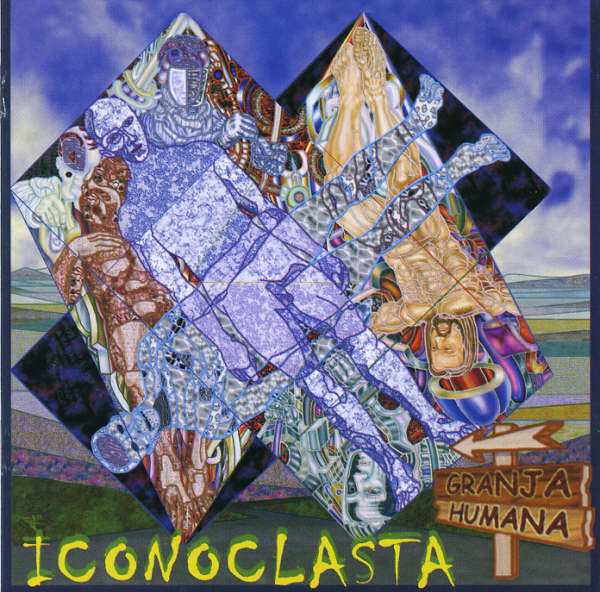 Though I’ve been reading about them in Exposé for years, this is the first Iconoclasta I’ve actually heard. I’m going to leave aside the concept-album aspect of Granja Humana (Human Farm in English), since, as instrumental music, “concept” is a matter of song titles, cover art, and inspiration, all of which are beyond the scope of music criticism. Suffice it to say they’re thinking about genetic engineering, and they don’t appear to be in favor of it. The music has a dark, ominous feel to much of it, not as oppressive as King Crimson, but full of minor keys. The presence of prominent keyboards and acoustic guitar help to lighten things a bit. The music is fairly complicated, and while none of the musicians are slouches, there is the feeling that they are playing near the limits of their technique, and their ideas are almost out of reach. Somehow I think that if they sounded more polished, I would enjoy them less. In general, their inspiration seems to come from classics like 70s Genesis, but with a near-jazzy twist. All compositions and arrangements are credited to guitarist/keyboardist Ricardo Moreno, and there is often a twin guitar lead shared with Ricardo Ortegón. Bassist Nohemi de Rubin provides a bright bottom end, complementing the melodies nicely. Victor Baldovinos keeps the pace going on the drums, though the production on his kit is rather flat, giving it a thumpy cardboard sound. One of the standout tracks is “El último de los Dodos,” which starts with a beautiful acoustic guitar duet, then progresses through numerous sections, including a quiet echoey interlude and a fast 5/4 riff. In any case, I’m glad I finally got to hear this interesting band, and recommend them to lovers of complex music that isn’t overly slick.
by Jon Davis, Published 2001-07-01
After years of cranking out a release every year or two, Iconoclasta’s last release was De Todos Uno in 1994, then nothing — until now. The band whose sound has changed at many points throughout their long career hasn’t let us down this time either, moving in some new directions while remaining within complex progressive rock envelope. Unlike their last one, this one has a bit more spirited compositional edge and attempts to reach well beyond its predecessor’s limits. Their sound is typically busy and full of melodic counterpoint, key and meter changes, and occasional dissonance — one might occasionally be reminded of some of the Spanish instrumental bands of late-70s, though Iconoclasta, and this album in particular, definitely has its own unique voice. The use of acoustic guitar-driven breaks within the otherwise predominantly busy electric program adds a sense of variety that some of their previous albums were lacking. The lineup remains unchanged, essentially two guitars, bass, and drums, with guitarist / composer Ricardo Moreno doubling on keys, augmented by a guest recorder player on one track. While the album is entirely instrumental, it is based on a futuristic concept of “The Human Farm,” where new lives can be genetically engineered to precise specifications; since there are no lyrics, the concept remains a socio-political statement that might be overlooked without reading the booklet or knowing the song titles. One major gripe is the mediocre sound / mixdown quality, which all but wipes out drummer Baldovinos’ cymbal work and presents a midrange and bass-heavy mix that kills much of the dynamics. That quibble aside, Iconoclasta are back on the right track. A welcome return!
by Peter Thelen, Published 2001-03-01
Iconoclasta is back, but you would never have known it from how little fanfare this latest release has received. In fact, it seems to have basically slipped under the radar of most progressive rock fans. This new album is entirely instrumental, and is a concept work concerned with themes such as genetic engineering and cloning. This concept doesn’t exactly translate into the music, however, which consists mostly of jams led by founding member Ricardo Ortegón (guitar). While he and bassist Nohemi de Rubin are more than capable of holding up their end, one gets the sense this could as easily have been an album about topographic oceans and unicorns. There is also a disturbing sense of auto-pilot on some of the tracks, such as “Alchemy,” whereas “Today the Sheep, Tomorrow the Shepherd” lacks any energy or punch. A soft, lazy fusion has crept into the once pyrotechnic symphonic rock, and one yearns for the days when this band employed keyboards in a substantial way. This is not to say that the entire album is a wash; “Living Wisdom” starts with a duet of acoustic guitar and recorder from guest Greta Romero Silva, and evolves into some more aggressive material. This is probably the most successful example of contrasting between the concepts of present and past through the music. The bottom line, though, is that Iconoclasta has much better stuff available, and this release just isn’t anything to write home about.
by Sean McFee, Published 2001-03-01
Filed under: New releases, Issue 22, 2000 releases
Related artist(s): Iconoclasta
What's new
These are the most recent changes made to artists, releases, and articles.
- Review: Kolman & Calvert - The Pink Carnage of Cartilago
Published 2026-10-20 - Review: Brand X - Theory of Nothing
Published 2026-10-19 - Review: Jeff Greinke - Land of Ice and Fog
Published 2026-10-18 - Release: Gustavo Denouard - Escape From The Real World
Updated 2026-10-17 00:25:56 - Release: Rudy Adrian - Southern-isles-sketchbook
Updated 2026-10-17 00:22:48 - Release: Kuhn Fu - Gam Gum Sopon
Updated 2026-10-17 00:20:23 - Release: Jeff Pearce - Infinite Ambient - Autumn Light (For Harold Budd)
Updated 2026-10-17 00:17:16 - Release: Aux_Out - Theologia Signalis
Updated 2026-10-17 00:13:08 - Review: Lumsk - Einsemda
Published 2026-10-17 - Release: Satoko Fujii Orchestra Tokyo - Kappa Ondo
Updated 2026-10-16 15:10:41 - Release: Andrew Leigh - Magician
Updated 2026-10-16 15:07:16 - Artist: Andrew Leigh
Updated 2026-10-16 15:05:54 - Release: Sonar - Movements and Interludes
Updated 2026-10-16 15:01:38 - Release: Strawbs - 50 Years On - Grave New World Live
Updated 2026-10-16 14:58:14 - Release: Leagus - Ulli
Updated 2026-10-16 14:49:00 - Release: Peter Daltrey - Three Windows
Updated 2026-10-16 14:47:37 - Release: Inclusion Principle - post_[*]
Updated 2026-10-16 14:46:12 - Review: Emily A. Sprague - Cyano
Published 2026-10-16 - Release: Fernando Molinari - Built by Elements
Updated 2026-10-15 23:13:08 - Release: Fernando Molinari - Reaching Inside
Updated 2026-10-15 23:11:16
 This work
is licensed under a Creative Commons Attribution-NonCommercial-ShareAlike 3.0 Unported License.
This work
is licensed under a Creative Commons Attribution-NonCommercial-ShareAlike 3.0 Unported License.