
Exposé Online
What's old
Exposé print issues (1993-2011)
- 1 (October 1993)
- 2 (February 1994)
- 3 (May 1994)
- 4 (August 1994)
- 5 (October 1994)
- 6 (March 1995)
- 7 (July 1995)
- 8 (November 1995)
- 9 (March 1996)
- 10 (August 1996)
- 11 (February 1997)
- 12 (May 1997)
- 13 (October 1997)
- 14 (February 1998)
- 15 (July 1998)
- 16 (January 1999)
- 17 (April 1999)
- 18 (November 1999)
- 19 (May 2000)
- 20 (October 2000)
- 21 (March 2001)
- 22 (July 2001)
- 23 (December 2001)
- 24 (April 2002)
- 25 (September 2002)
- 26 (February 2003)
- 27 (August 2003)
- 28 (December 2003)
- 29 (April 2004)
- 30 (September 2004)
- 31 (March 2005)
- 32 (September 2005)
- 33 (May 2006)
- 34 (March 2007)
- 35 (January 2008)
- 36 (October 2008)
- 37 (July 2009)
- 38 (July 2010)
- 39 (Summer 2011)
Reviews
Agitation Free — 2nd
(Garden of Delights CD 071, 1973/2002, CD)
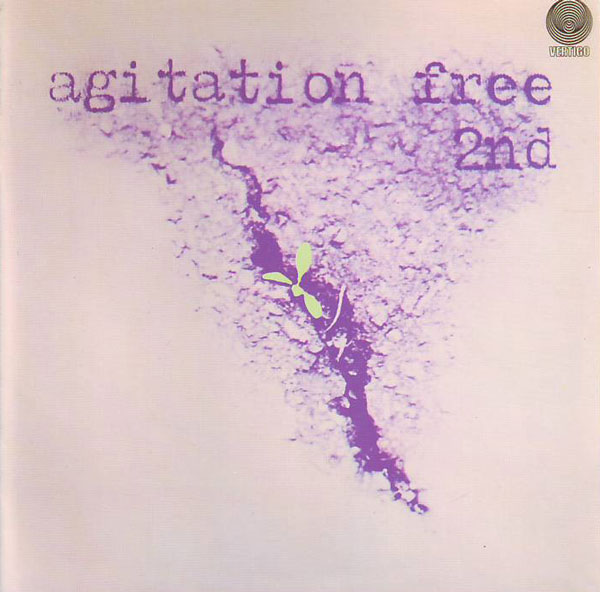
Early 70s Germany provided the environment for a massive number of inventive and experimental albums, but the closest of these to what was going on in the San Francisco bay area had to be Agitation Free. In many ways Agitation Free was the German Grateful Dead, basing a lot of their music in longform, guitar-led improvisations that were also influenced by travelling abroad and absorbing the music of other cultures. This impact was strongest on their first album Malesch, by their 2nd they had moved a bit closer to a more unadulterated space rock with the world influences acting more as coloring. What really lifts Agitation Free is their powerful sense of melody, with a lot of their improvisations starting as atmospheres and evolving into ecstatic peaks, very close to the methods the Dead were using at the time with "Dark Star." Agitation Free also melded the Bay Area and Kosmische approaches, including the heavy use of synthesizer effects and Mellotron, but where so much of this music often tended towards the abstract and textural, Agitation Free also grounded the exploration in songs or song fragments. The results were deeply emotional and brazenly psychedelic with a balance that really has never been quite matched. Perhaps only the quieter moments of the early Ash Ra Tempel albums touched on similar territory.
by Mike McLatchey, Published 2016-12-29
Here is a band that was born alongside fellow German groups such as Ashra, Guru Guru, etc. Chris Franke was a member before moving on to replace Klaus Schulze in Tangerine Dream. Unlike TD (which was always at the forefront) though, Agitation Free pursued basically what Pink Floyd had done three years before, something that for Germany was likely new at the time. As part and parcel with archive music, some of AF’s work merits praise; some is sketchy experimentation that doesn’t age well. A trip to the Middle East in 1971 imparted an Arabic veneer to Malesch that dates it as 60s throwback material, as does the guitar playing. Michael Hoenig was their electronics expert and it’s easy to see why he ended up in TD later. His synth work here provides most of what is unique. (Peter Michael Hamel guests on organ as well). But I much prefer when they limit themselves to simply guitar, bass, drums, and organ, and build up space jams, which they do much much better on 2nd. Now this is more like it! Here, all of the feebleness of Malesch is rectified: tighter bass / drums coalition; stronger guitar playing, with a deeper sonic capacity (Malesch’s guitar sounded like The Yardibirds in 1967); better ensemble dynamics; and limited experimenting, fitting with the tone of the songwriting, rather than fighting it. The album’s character is bright, sunny, and American-influenced, with prevalent melodies in the guitar department, making 2nd a consistently professional presentation that’s worth checking out. I would advise avoiding Malesch.
by Mike Ezzo, Published 2003-08-01
Filed under: Reissues, 2002 releases, 1973 recordings
Related artist(s): Agitation Free, Michael Hoenig, Lutz "Lüül" Ulbricht
What's new
These are the most recent changes made to artists, releases, and articles.
- Review: Stick Men - Let's THRAK Again
Published 2026-10-10 - Release: The Instigations - Miscreantics
Updated 2026-10-09 00:35:34 - Review: Shane Morris - Tenochtitlan to Etzanoa
Published 2026-10-09 - Review: Malcolm Galloway - Stare
Published 2026-10-09 - Review: The Shades - Basement Sessions 1978-1980
Published 2026-10-08 - Release: Robeone - If You Don't Know What It Is, It Must Be Jazz
Updated 2026-10-07 20:15:02 - Review: Xavi Reija Electric Quintet - Nu Breed
Published 2026-10-07 - Release: 4Element - Double Life
Updated 2026-10-06 23:15:57 - Release: 4Element - Duplicity
Updated 2026-10-06 23:13:32 - Release: 4Element - Living Spirit
Updated 2026-10-06 23:12:08 - Artist: 4Element
Updated 2026-10-06 23:07:43 - Artist: Mark Mulholland
Updated 2026-10-06 13:20:08 - Review: Edena Gardens - Quintessence
Published 2026-10-06 - Review: Stratosphere - Sphere I
Published 2026-10-06 - Release: We the Gleaners - Graze
Updated 2026-10-05 13:09:19 - Release: We the Gleaners - We the Gleaners
Updated 2026-10-05 13:08:39 - Artist: We the Gleaners
Updated 2026-10-05 13:07:39 - Release: Compassionizer - The Faithful of the Land
Updated 2026-10-05 13:02:36 - Release: Mark Mulholland - Down Silver Streets
Updated 2026-10-05 12:52:27 - Artist: Down Silver Streets
Updated 2026-10-05 12:50:05
 This work
is licensed under a Creative Commons Attribution-NonCommercial-ShareAlike 3.0 Unported License.
This work
is licensed under a Creative Commons Attribution-NonCommercial-ShareAlike 3.0 Unported License.