
Exposé Online
What's old
Exposé print issues (1993-2011)
- 1 (October 1993)
- 2 (February 1994)
- 3 (May 1994)
- 4 (August 1994)
- 5 (October 1994)
- 6 (March 1995)
- 7 (July 1995)
- 8 (November 1995)
- 9 (March 1996)
- 10 (August 1996)
- 11 (February 1997)
- 12 (May 1997)
- 13 (October 1997)
- 14 (February 1998)
- 15 (July 1998)
- 16 (January 1999)
- 17 (April 1999)
- 18 (November 1999)
- 19 (May 2000)
- 20 (October 2000)
- 21 (March 2001)
- 22 (July 2001)
- 23 (December 2001)
- 24 (April 2002)
- 25 (September 2002)
- 26 (February 2003)
- 27 (August 2003)
- 28 (December 2003)
- 29 (April 2004)
- 30 (September 2004)
- 31 (March 2005)
- 32 (September 2005)
- 33 (May 2006)
- 34 (March 2007)
- 35 (January 2008)
- 36 (October 2008)
- 37 (July 2009)
- 38 (July 2010)
- 39 (Summer 2011)
Reviews
Delirium — Sesta Strada lungo il Tempo
(Black Widow BWR290, 2026, CD / LP / DL)
by Henry Schneider, Published 2026-08-03
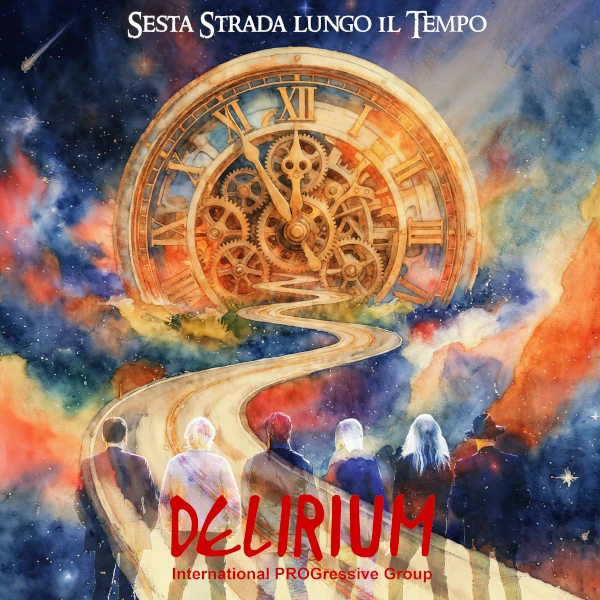
Delirium's Sesta Strada lungo il Tempo is the latest chapter in a musical journey that now spans more than five decades. Emerging from the first wave of Italian progressive rock in the early 70s, surviving a hiatus of more than thirty years, and returning with a string of increasingly confident releases, the Genoese group continues to explore familiar themes of time, memory, travel, and the human condition. More importantly, they continue to do so with a vitality that many younger bands would envy. It has been more than a decade since I last encountered the band on record, yet the personnel changes since then have been minimal. The primary addition is veteran drummer Enrico Tixi, whose background extends well beyond progressive rock into blues, classic rock, southern rock, and hard rock. His presence proves significant throughout the album, providing a muscular groove and rhythmic confidence that strengthens the band's already distinctive blend of jazz-inflected prog, melodic rock, flute-driven passages, and atmospheric textures. The album opens with "Schiavo della Viltà," a 22-minute epic that immediately establishes the record's ambitions. Rather than functioning as a suite built around a single idea, it continuously evolves, shifting moods, tempos, and instrumental colors with remarkable fluidity. Delirium understands that long-form composition succeeds through variety, and there is never a sense of the band lingering too long in any one place. Lyrical passages give way to harder-edged sections, moments of beauty are contrasted by darker textures, and the music remains engaging throughout its considerable duration. That same unpredictability characterizes the remainder of the album. "Clochard" occasionally recalls the cinematic darkness of Goblin, while "Riposo del Pirata" navigates territory that suggests a meeting point between the grand tradition of Italian symphonic prog and a more urban jazz-rock sensibility. Sinister vocal chants, Hammond organ flourishes, and dramatic shifts in atmosphere lend the piece a distinctly theatrical character. Elsewhere, "Del Ritorno la Strada" begins with a supple jazz-inflected bass figure before expanding into a rich arrangement of piano, guitar, and keyboards. A large part of the album's success lies in the contributions of its individual players. Martin Grice's flute, saxophone, and other wind instruments remain central to Delirium's identity, serving as a signature voice that instantly distinguishes the group from their contemporaries. Ettore Vigo's keyboards provide both elegance and power, Michele Cusato's guitar work moves effortlessly between restraint and aggression, and Alessandro Corvaglia delivers another strong vocal performance, balancing emotional nuance with dramatic intensity. What makes Sesta Strada lungo il Tempo particularly impressive is that it does not feel like the work of a veteran band merely revisiting past glories. Instead, it sounds like a group that remains creatively engaged and fully invested in its musical vision. While the album draws upon the stylistic hallmarks that have defined Delirium throughout its career, it never feels trapped by nostalgia. The result is one of the strongest releases in the band's catalog and perhaps the most fully realized statement of their later years. It sets a remarkably high standard — one that may prove difficult even for Delirium themselves to surpass.
Filed under: New releases, 2026 releases
Related artist(s): Delirium
More info
http://btf.it/en/prodotto/sesta-strada-lungo-il-tempo-cd/
What's new
These are the most recent changes made to artists, releases, and articles.
- Review: Kavus Torabi - October by Name
Published 2026-10-27 - Release: Spirits Burning & Michael Moorcock - The End of All Songs - Part 2
Updated 2026-10-26 15:58:08 - Release: Spirits Burning & Michael Moorcock - The End of All Songs - Part 1
Updated 2026-10-26 15:51:47 - Release: Paolo Almeida - Love in Motion
Updated 2026-10-26 14:05:27 - Artist: Paolo Almeida
Updated 2026-10-26 14:01:26 - Release: Paulina Fae - The Way That Only Night Can See
Updated 2026-10-26 13:55:02 - Review: Spontaneous Rex - Cataclysm
Published 2026-10-26 - Release: Phillip Golub - Loop 8/9
Updated 2026-10-25 22:16:36 - Release: Seveneves - Rush Hour Secrets
Updated 2026-10-25 19:02:21 - Artist: Seveneves
Updated 2026-10-25 19:01:30 - Release: Khu.éex’ - Khu-Tron: Cloned Hardware
Updated 2026-10-25 18:51:58 - Release: Los Nuevos Médiums - Los Nuevos Médiums
Updated 2026-10-25 18:49:27 - Artist: Los Nuevos Médiums
Updated 2026-10-25 18:47:19 - Release: Sendelica - Nirmata II: Journey to the Stars
Updated 2026-10-25 18:41:44 - Release: Jay Tausig - An Introduction to Jay Tausig
Updated 2026-10-25 18:38:40 - Release: La Nouvelle Musique - Celluloid
Updated 2026-10-25 18:36:32 - Release: Chercán - Canto de Silicio
Updated 2026-10-25 18:20:08 - Release: Andy Juhl - Go Where the Sun Goes
Updated 2026-10-25 18:15:21 - Artist: Andy Juhl
Updated 2026-10-25 18:14:32 - Review: Arabs in Aspic - Sorgens Kapittel
Published 2026-10-25
 This work
is licensed under a Creative Commons Attribution-NonCommercial-ShareAlike 3.0 Unported License.
This work
is licensed under a Creative Commons Attribution-NonCommercial-ShareAlike 3.0 Unported License.