
Exposé Online
What's old
Exposé print issues (1993-2011)
- 1 (October 1993)
- 2 (February 1994)
- 3 (May 1994)
- 4 (August 1994)
- 5 (October 1994)
- 6 (March 1995)
- 7 (July 1995)
- 8 (November 1995)
- 9 (March 1996)
- 10 (August 1996)
- 11 (February 1997)
- 12 (May 1997)
- 13 (October 1997)
- 14 (February 1998)
- 15 (July 1998)
- 16 (January 1999)
- 17 (April 1999)
- 18 (November 1999)
- 19 (May 2000)
- 20 (October 2000)
- 21 (March 2001)
- 22 (July 2001)
- 23 (December 2001)
- 24 (April 2002)
- 25 (September 2002)
- 26 (February 2003)
- 27 (August 2003)
- 28 (December 2003)
- 29 (April 2004)
- 30 (September 2004)
- 31 (March 2005)
- 32 (September 2005)
- 33 (May 2006)
- 34 (March 2007)
- 35 (January 2008)
- 36 (October 2008)
- 37 (July 2009)
- 38 (July 2010)
- 39 (Summer 2011)
Reviews
Abyssian — Let Me Die under the Stars
(Black Widow BWR293, 2026, CD / LP / DL)
by Henry Schneider, Published 2026-08-06
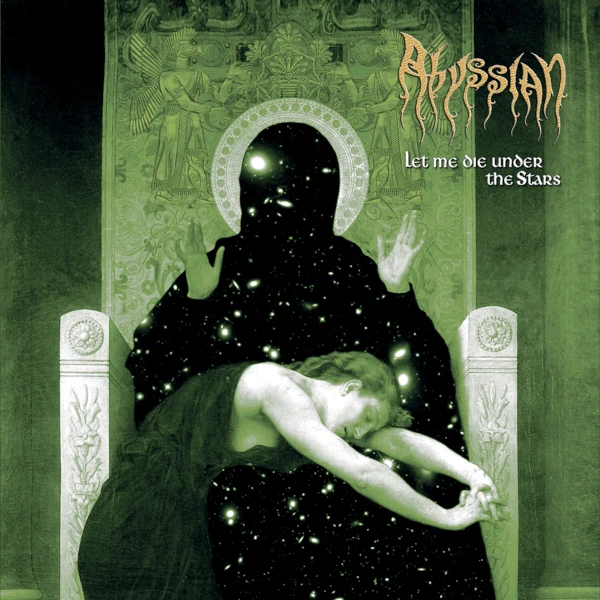
Abyssian makes its Exposé debut with Let Me Die under the Stars, a release that arrived accompanied by an intriguing promo sheet describing a world of submerged civilizations, Atlantean mysteries, ancient aliens, and Sumerian mythology. Given the album title, cover artwork, and the band's roots in Italy's darker progressive underground, I expected something that blended gothic atmosphere, doom, and perhaps a measure of the cinematic grandeur often associated with classic Italian progressive rock. Instead, what I found was nearly an hour of repetitive riffing that rarely develops its ideas beyond their initial presentation. The opening instrumental, "In My Time of Forlorn," begins promisingly with rainfall and a reflective guitar theme. The melancholy mood and slight jazz inflection suggest a more nuanced direction, but the composition never really goes anywhere. At only four-and-a-half minutes, it already suffers from a lack of development, drifting into directionless improvisation before it has established enough substance to justify its running time. The centerpiece of the album is the three-part title suite, which occupies almost 37 minutes of the program. "Let Me Die under the Stars I" launches with crushing guitar chords, distorted bass, and a funereal doom-metal pulse. The lead guitar frequently struggles to rise above the dense rhythm section, and when the vocal enters — a half-spoken, half-sung baritone chant delivered in English — it provides little relief from the monochromatic backdrop. The problem is not heaviness itself; it is the near absence of variation. The same distorted bass figures and percussive guitar patterns repeat relentlessly, creating the sensation that the band has mistaken persistence for development. Parts II and III continue along much the same path. There are occasional glimpses of stronger ideas — a more open passage here, a melodic guitar phrase there, a brief narrated interlude near the end of Part III — but these moments are fleeting. Rather than expanding the concepts introduced in the opening section, the suite largely reiterates them. By the time the entire trilogy reaches its conclusion, what should have felt monumental instead feels exhausting. This is where the disconnect between concept and execution becomes most apparent. The band's promotional material highlights themes involving lost civilizations, cosmic mysteries, and ancient mythology, yet little of that atmosphere emerges from the music itself. One can imagine fertile opportunities for evocative keyboards, dramatic dynamics, or cinematic storytelling, but the album remains stubbornly locked into a narrow doom-metal framework. The mythology may exist in the lyrics, but musically it is difficult to perceive beneath the endless churn of distorted guitar and bass. "Back to Tilmon + AD2025" offers another opportunity for change, beginning with a repeated guitar figure that briefly raises hopes of a different approach. Unfortunately, the familiar barrage of distorted riffs soon returns, and the track proceeds as another extended workout in repetition. At nine minutes, it feels considerably longer. The album concludes with a cover of Roxy Music's "Avalon," and this choice initially seemed intriguing. Bryan Ferry's original is built on elegance, restraint, and atmosphere. Abyssian transform it into something entirely different, stretching the song to more than eight minutes and subjecting it to the same lumbering doom-metal treatment heard throughout the album. Reinvention can often reveal hidden dimensions within familiar material; here it merely strips away the qualities that made the original memorable in the first place. Abyssian clearly possess commitment to their aesthetic, and Roberto Messina's long history stretching back to Sinoath demonstrates that this music comes from a deeply held artistic vision. However, Let Me Die under the Stars mistakes duration for depth and repetition for hypnosis. What promises to be an immersive journey through ancient mysteries instead becomes a relentlessly one-dimensional listening experience. Fans of extremely repetitive dark doom metal may find themselves more receptive, but for this listener the album's 49 minutes felt considerably longer than the clock suggested.
Filed under: New releases, 2026 releases
Related artist(s): Abyssian
More info
http://abyssian1.bandcamp.com/album/let-me-die-under-the-stars
What's new
These are the most recent changes made to artists, releases, and articles.
- Review: Kavus Torabi - October by Name
Published 2026-10-27 - Release: Spirits Burning & Michael Moorcock - The End of All Songs - Part 2
Updated 2026-10-26 15:58:08 - Release: Spirits Burning & Michael Moorcock - The End of All Songs - Part 1
Updated 2026-10-26 15:51:47 - Release: Paolo Almeida - Love in Motion
Updated 2026-10-26 14:05:27 - Artist: Paolo Almeida
Updated 2026-10-26 14:01:26 - Release: Paulina Fae - The Way That Only Night Can See
Updated 2026-10-26 13:55:02 - Review: Spontaneous Rex - Cataclysm
Published 2026-10-26 - Release: Phillip Golub - Loop 8/9
Updated 2026-10-25 22:16:36 - Release: Seveneves - Rush Hour Secrets
Updated 2026-10-25 19:02:21 - Artist: Seveneves
Updated 2026-10-25 19:01:30 - Release: Khu.éex’ - Khu-Tron: Cloned Hardware
Updated 2026-10-25 18:51:58 - Release: Los Nuevos Médiums - Los Nuevos Médiums
Updated 2026-10-25 18:49:27 - Artist: Los Nuevos Médiums
Updated 2026-10-25 18:47:19 - Release: Sendelica - Nirmata II: Journey to the Stars
Updated 2026-10-25 18:41:44 - Release: Jay Tausig - An Introduction to Jay Tausig
Updated 2026-10-25 18:38:40 - Release: La Nouvelle Musique - Celluloid
Updated 2026-10-25 18:36:32 - Release: Chercán - Canto de Silicio
Updated 2026-10-25 18:20:08 - Release: Andy Juhl - Go Where the Sun Goes
Updated 2026-10-25 18:15:21 - Artist: Andy Juhl
Updated 2026-10-25 18:14:32 - Review: Arabs in Aspic - Sorgens Kapittel
Published 2026-10-25
 This work
is licensed under a Creative Commons Attribution-NonCommercial-ShareAlike 3.0 Unported License.
This work
is licensed under a Creative Commons Attribution-NonCommercial-ShareAlike 3.0 Unported License.